

Flat Tire Roadside Service Cost in Atlanta
Quick Answer: Roadside flat tire service in metro Atlanta typically costs $50 to $95 if a usable spare is available, similar to a standard jump-start call. The bigger issue for a growing share of drivers isn’t price, it’s that the spare may not exist at all. Recent Consumer Reports testing found that 60 percent of new cars no longer include a spare tire, replaced instead by run-flat tires or a temporary inflator kit that doesn’t work on every kind of puncture. If your car falls into that group, a flat tire often means a tow to a tire shop rather than a quick roadside swap, which is worth knowing before it happens, not after.
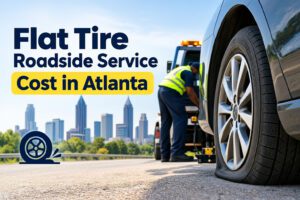
A flat tire used to have one obvious fix: pop the trunk, pull out the spare, and be back on the road in twenty minutes. That’s no longer true for a majority of new vehicles, and most drivers don’t find out until they’re already stranded.
What Flat Tire Roadside Service Actually Costs
If a usable spare, either a full-size or space-saver donut, is present in the vehicle, roadside tire service in metro Atlanta generally runs $50 to $95, comparable to the cost of a jump-start. This covers removing the damaged tire and mounting the spare on the shoulder or wherever the vehicle is safely stopped. After-hours calls carry the same 25 to 60 percent surcharge structure common to other roadside services.
If no usable spare exists, the job changes entirely. At that point, the vehicle typically needs to be towed to a tire shop rather than serviced roadside, which shifts the cost toward standard local towing rates, generally $75 to $125, on top of whatever the replacement tire itself costs at the shop.
Why Flat Tires Happen
Understanding the cause matters because it affects whether the tire can be safely patched or needs full replacement. Federal data shows tire-related crashes killed 511 people in 2024 alone, with the National Highway Traffic Safety Administration identifying screws, nails, and other sharp road debris as among the most common causes of sudden punctures and blowouts. Potholes, broken glass, and debris left behind after storms round out the most frequent culprits on Atlanta roads specifically.
A puncture in the center tread from a nail or screw is often repairable. Sidewall damage, a puncture near the shoulder of the tire, or damage from a low-pressure “pinch flat” against a pothole edge usually isn’t, and requires full tire replacement rather than a patch.
The Disappearing Spare Tire
This is the detail most drivers don’t discover until it’s too late. Consumer Reports testing found that 60 percent of new cars now come without a spare tire at all, a sharp increase from roughly a third of new vehicles just a few years earlier. In place of a spare, automakers typically include either run-flat tires or a temporary inflator kit, a sealant-and-compressor combination stored where the spare used to sit.
The inflator kit is the more limited of the two options. It generally only works on a puncture to the center tread where the object causing it stays lodged in the tire, and it does nothing for sidewall damage, a large tear, or a full blowout. A driver who assumes their car has a spare, then discovers a sealant kit that can’t address their specific damage, is often looking at a tow to a tire shop rather than a quick roadside fix.
Run-Flat Tires: What Changes If You Have Them
Run-flat tires solve the disappearing-spare problem differently. These tires are built with reinforced sidewalls that allow driving roughly 50 miles at reduced speed after a puncture, enough to reach a tire shop under most circumstances without stopping roadside at all. That convenience comes with tradeoffs: run-flats typically cost more than standard tires, and once a run-flat has actually been driven flat, it generally can’t be repaired and needs full replacement rather than a patch.
Knowing which category your vehicle falls into, spare tire, run-flat, or inflator kit only, changes what happens the moment a tire goes flat. Checking the trunk or owner’s manual before an emergency, not during one, is worth the five minutes it takes.
What to Do If You Have a Flat and No Spare
Check whether the puncture object is still in the tire. If a nail or screw is visibly still lodged in the center tread, that’s the best-case scenario for a possible sealant fix or later repair rather than full replacement.
Don’t attempt an inflator kit on sidewall damage. These kits aren’t designed for it and won’t hold, wasting time before the actual fix, a tow, happens anyway.
Call for a tow rather than attempting to drive on a flat, even a short distance, since driving on a fully deflated tire can damage the wheel itself and turn a tire-only repair into a more expensive wheel replacement.
Tell dispatch whether a spare is available. This single detail determines whether the call is a roadside tire change or a tow to the nearest shop, and knowing in advance speeds up the right response.
Safety While Waiting for Help
Pull as far off the roadway as possible, ideally past the white fog line and away from the travel lane entirely, before stopping.
Keep hazard lights on the entire time you’re stopped, and stay inside the vehicle if you’re on a highway shoulder with fast-moving traffic nearby.
Avoid standing directly behind or beside the vehicle if you do need to exit, since a stopped vehicle on a shoulder remains a real hazard until help arrives.
Coverage Across Metro Atlanta and Surrounding Counties
PMA Transportation Services provides flat tire roadside service across metro Atlanta and the surrounding counties, including Midtown (30308), Buckhead (30305), Decatur (30030), Marietta (30060), Lawrenceville (30044), and Woodstock (30188), with towing available immediately if no usable spare is present.
Why PMA Transportation Services
PMA Transportation Services handles flat tire calls with an honest assessment upfront: if a spare exists and the damage is straightforward, that gets resolved roadside quickly and affordably. If the vehicle has no spare, run-flats that have already failed, or damage an inflator kit can’t address, that gets communicated clearly so the next step, a tow to a shop, happens without wasted time on a fix that was never going to work.
Flat Tire Roadside Service Frequently Asked Questions
How much does a roadside flat tire service cost in Atlanta? Generally $50 to $95 if a usable spare is available, similar to the cost of a jump-start call.
What happens if my car doesn’t have a spare tire? The vehicle typically needs to be towed to a tire shop rather than serviced roadside, since most inflator kits only handle minor center-tread punctures and can’t fix sidewall damage or a full blowout.
How many new cars actually come without a spare tire? According to Consumer Reports testing, 60 percent of new vehicles now lack a spare tire, relying instead on run-flat tires or a temporary inflator kit.
Can I drive on a flat tire to get to a shop myself? It’s not recommended, even for a short distance. Driving on a fully deflated tire can damage the wheel itself, turning a tire-only repair into a more expensive wheel replacement.
Are run-flat tires repairable after they’ve been driven flat? Generally no. Once a run-flat tire has actually been driven while flat, it typically needs full replacement rather than a patch or repair.
Keep Reading
- Roadside Battery Jump-Start Cost in Atlanta
- 24-Hour Emergency Towing Near Me: Metro Atlanta Response Times
- How Much Does Towing Cost? Guide by Service Type
Flat tire right now? Contact PMA Transportation Services or view our full towing and roadside services. Call (844) 762-8726, available 24/7.